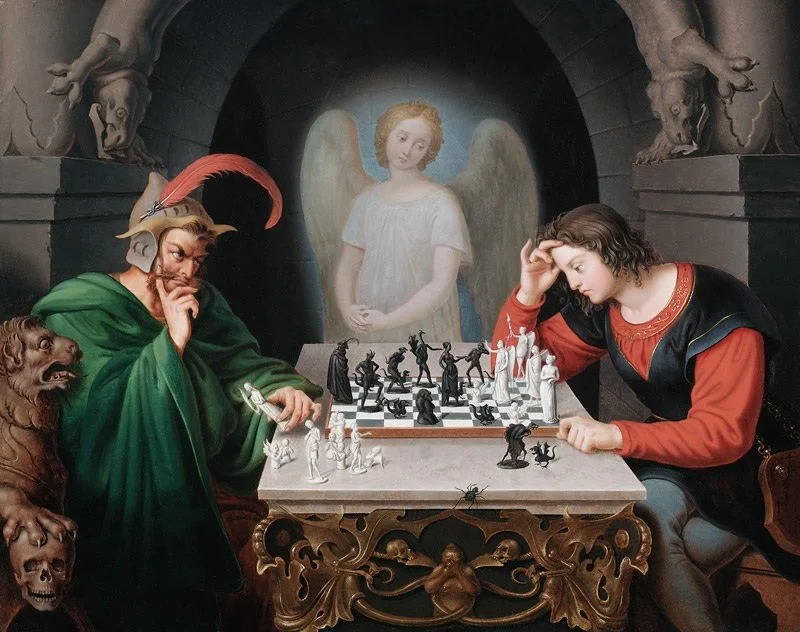
Friedrich Retzsch’s 1831 painting Die Schachspieler ("The Chess Players") is a fascinating piece of art merging Christian theology and chess. It depicts a man playing with white pieces and the devil playing with black. There was obvious imbalance in material count and number of pieces on the board. The devil was trying to intimidate, the man was seemingly hopeless, and the angel watching at the side was sorrowful.
Some of you may have read about the story where Paul Morphy, supposedly the world chess champion of his time, exclaiming that "there is one more move!", preached by pastors and preachers, seemingly suggesting that white was not lost. But this story was so wrong on so many levels.
1. The true story
Paul Morphy wasn't in a museum, he was at a dinner party. He didn't say there's "one more move" but he thought he could win it against his party host and fellow attendees with the white pieces.
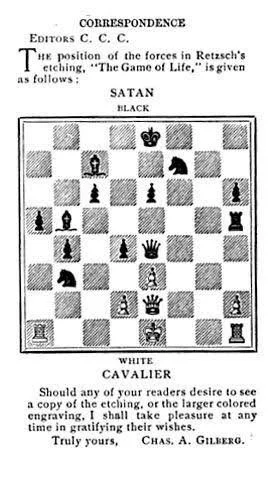
He looked at the line-engraving copy of the art, assumed the pieces in it to represent the respective pieces of real chess, and thought there was still counterplay that he could use to beat other non-seasoned players. Which, after setting up the position on an actual board, he went on to beat several of them that evening.
The art wasn't about the devil putting the man in checkmate in the first place, it was putting him in an absolutely lost position. But would Paul Morphy lose against his rivals of his time?
2. The Paul Morphy reality
Paul Morphy was the unofficial world chess champion of his day, even with modern day chess theories, he would be down a full queen and still easily beat me. Let alone back in his days playing not his strongest rivals but other non-master chess players.
If Magnus Carlsen or Gukesh were down a full queen and play against me, they would beat me 100 out of 100 times. But the same couldn't be said of either of them not missing a queen but just a minor piece against their fellow super Grandmasters. Heck, even Levy Rozman, an International Master, could've beaten them if they were missing a knight or a bishop.
A chess prodigy like Morphy could easily out-calculate, swindle, and trap his opponents at the dinner party and go on to beat them. That is purely due to the skill gap between a Grandmaster (he wasn't one because titles weren't created yet) and a casual player. Back then his Elo was probably 2700 (Elo system was not invented yet either) and his opponents were probably around 1000.
However, if he played against his contemporaries, like Adolf Anderssen, he would probably just resign before they reach that position.
3. Irony of "one more move"
You know what's one more move than checkmate? Mate-in-1. I, a humble 1900-rated puzzle solver, can find mate-in-4 with ease. That's FOUR more moves than checkmate and THREE more than what the preachers used to make the non-chess playing laity feel good. And the position on the board was definitely not close of mate-in-4, at least not yet.
Grandmasters and International Masters rarely play until checkmate because when they already knew a position is mathematically lost, they trust their opponents to finish them off if they played on. So, playing till checkmate is a waste of energy. Even people at my level of 1400-1500 on Chess.com would resign after we knew we made a game-losing blunder. So, having one more move wouldn't really make any chess sense.
But is it theologically sound? Well, with the right exciting and charismatic voice, a preacher may convince you a miracle is coming to save your mate-in-1 position. But, realistically, that's not how we are called to place our hope in God when we lose our jobs, break up with our partners, or watch our finances collapse.
4. The true theological truths
If we strip away the fluff, the intersection of chess and the painting actually reveals two far deeper spiritual truths.
4a. Mental Resignation.
From the painting, we see the man in despair in the losing position. Put ourselves in his shoes, when we experience despair, what we no longer see? Hope. Because we have already mentally resigned the position, everything we saw is only how we are going to lose. We wouldn't be able to play what Gothamchess calls 'Hope Chess' (where you play cheese moves and HOPE your opponent misses it).
If you can't see it as losing, still buying the feel-good message of "one more move", I don't blame you. Not everyone is obsessed about chess puzzle as I do. But you have to then ask yourself, why did the man look resigned? Why was the angel sorrowful?
He looked resigned because he believed he lost already. And while the artist wasn't a chess player, did not mean to paint the board as an actual played position, he did mean to show how dire the situation was, since the man was playing for his soul.
Whereas a neutral chess player, not battling for our souls, would think of possible counterplays, tactics, or tricks (look for checks, captures, or attacks) that could force a stalemate, create a trap, or force perpetual checks. Because we aren't resigned from our fate yet, we could be removed from the desperation presented to us on the chess board. We know we are losing, but we also know not much is at stake. Same could not be said of the man in the painting and anyone in the same allegorical position.
4b. How the man got there in the first place?
Fact of the matter is, the board is showing that white is losing terribly. No matter whose move is it, white is going to lose both his rooks in the next few moves. Therefore, why are we assuming a miracle of "one more move" would happen? Besides, if the man was playing against the devil, then it would be hopeless since he is probably playing like an engine, if not cheat using an engine (no butt plug required). No matter how much you pray for a miracle, even the angel beside you couldn't save you.
Chess has its principles and fundamentals but the man in the painting violated all of them.
A) King safety – king was in the starting position (e1), not castled to either sides
B) Material balance – pieces were all gone except for 2 rooks, a queen, and a couple of pawns, while black had almost the full strength less a pawn and a rook.
C) Pieces coordination and development – the fact that the pieces were all gone meant they were either poorly coordinated or poorly developed into squares to be captured for free.
D) Space control – white pieces never crossed the 3rd rank while black swarmed past the 4th (wrt white).
The man got to his predicament because he did not develop his pieces properly, he did not castle early to ensure king safety, and he probably played some nonsensical opening that blundered all his pieces by the time they entered the middle game. He basically defied all chess principles.
This showed us one important truth — if we don't stay principled, we would end up in a losing and hopeless position. But if we do stay principled, holding fast to Biblical wisdom, staying disciplined in gaining theological knowledge, standing firm to our moral values, then we would not end up putting ourselves in a losing position, but a winning one. We need God to guide us along the way but we wouldn't need Him to miraculously save us.